The Importance of Bonded Warehouse Management
In the global supply chain, bonded warehouses play a crucial role as transit and storage hubs, helping businesses optimize import and export operations. However, the efficiency of a bonded warehouse depends not only on its size or location but also on its inventory management strategy. Choosing the right inventory management method can significantly impact costs, turnover speed, and supply chain efficiency. Among the most commonly used methods are FIFO (First In, First Out), LIFO (Last In, First Out), and FEFO (First Expired, First Out), each offering distinct advantages and limitations.
An effective warehouse management strategy not only optimizes operational costs but also enhances inventory turnover speed, reducing the risk of long-term stockpiling and wastage. Additionally, it helps businesses minimize the risk of product deterioration, particularly for perishable or time-sensitive goods. More importantly, a well-structured warehouse management system contributes to improving supply chain performance, enabling businesses to maximize commercial advantages and quickly adapt to market fluctuations.
Today, businesses and companies in the industry are flexibly applying FIFO, LIFO, and FEFO models to optimize storage and distribution operations. Depending on the nature of the goods and customer demand, warehouse management systems are operated flexibly, helping businesses maximize benefits, control costs efficiently, and ensure the smooth and safe circulation of goods.
FIFO (First In, First Out) Method
FIFO (First In, First Out) is an inventory management method in which the oldest stock is used or sold first. This method is ideal for maintaining product quality, especially for items with expiration dates or strict storage requirements. In the food & beverage industry, FIFO ensures that products remain fresh and minimizes spoilage. In the pharmaceutical & cosmetics industry, it plays a vital role in preserving the effectiveness of medicines and personal care products. For the electronics & components sector, FIFO prevents obsolescence and ensures quality for end-users.
Besides minimizing long-term stockpiling, FIFO helps maintain product quality per international standards, allowing businesses to optimize inventory turnover, reduce storage costs, and improve cash flow by ensuring a steady movement of goods.

“FIFO enables businesses to manage inventory effectively, ensuring products do not become obsolete—an essential factor in the food and pharmaceutical industries.” – Prof. David Simchi-Levi, Supply Chain Expert at MIT.
However, FIFO has some drawbacks. This method requires large storage space, strict management, and high investment in technology like WMS or ERP. Additionally, it is unsuitable for commodities with fluctuating values, such as precious metals or fuel, as it may lead to financial losses. Arranging and moving goods according to FIFO can also be time-consuming, affecting warehouse efficiency.
By implementing FIFO systematically and scientifically, businesses have significantly reduced storage costs while ensuring the highest product quality before reaching customers. This is a key competitive advantage that helps businesses optimize their supply chain, improve operational efficiency, and strengthen their market reputation.
LIFO (Last In, First Out) Method
LIFO (Last In, First Out) is an inventory management method in which the most recently received goods are used or sold first. This approach is ideal for industries where storage time does not impact product quality or when inventory values fluctuate frequently. In the construction & materials sector, LIFO allows businesses to flexibly manage the distribution of steel, cement, and bricks without quality concerns. In the oil & mineral industries, this method enables companies to leverage price changes to maximize profits. For metals & industrial components, LIFO helps reduce storage costs due to the stackable and easily movable nature of these goods.
LIFO offers significant benefits for bonded warehouse management, particularly in fluctuating markets. By capitalizing on price changes, businesses can release the most recent inventory at higher costs, optimizing profitability when market prices rise. Furthermore, this method reduces operational costs, making it suitable for bulky goods with minimal storage time impact.

“LIFO is a powerful financial tool that provides businesses with greater flexibility in managing raw materials, particularly when prices fluctuate continuously.” – Dr. Christopher Tang, UCLA Anderson School of Management.
However, LIFO has several limitations. It is not suitable for perishable goods as it can lead to older stock being left unused, causing spoilage and waste. Additionally, LIFO may create challenges in complying with international accounting standards, as it affects financial reporting and tax calculations. Organizing warehouses based on LIFO can also decrease inventory turnover efficiency, especially in limited storage spaces.
By applying LIFO systematically and flexibly, businesses have optimized storage costs, leveraged market price fluctuations to increase profits, and ensured smooth and efficient storage and distribution processes.
FEFO (First Expired, First Out) Method
FEFO (First Expired, First Out) is more than just an inventory management method—it is a safeguard for product quality and brand reputation. Under this approach, expiration dates, rather than receipt dates, determine the order of stock movement. Any product nearing expiration is prioritized for release, allowing businesses to proactively manage product lifecycles, minimize expired stock risks, and maximize inventory value before products become unsellable.
FEFO is indispensable in industries requiring strict quality and safety controls. In the food & beverage sector, this system ensures that each batch moves in accordance with its expiration date, maintaining freshness for consumers. In pharmaceuticals & healthcare, FEFO is a “lifeline” preventing expired drugs from reaching the market while ensuring compliance with GSP (Good Storage Practice) and GDP (Good Distribution Practice) standards. In cosmetics & chemicals, this method helps preserve product effectiveness and stability, preventing degradation due to extended storage periods.
Beyond compliance, FEFO is a smart business strategy. Optimizing inventory turnover based on expiration dates not only reduces storage costs and waste but also provides a competitive advantage by delivering products in peak condition. This is especially crucial for brands aiming to build consumer trust, as nothing leaves a better impression than a fresh, high-quality product.
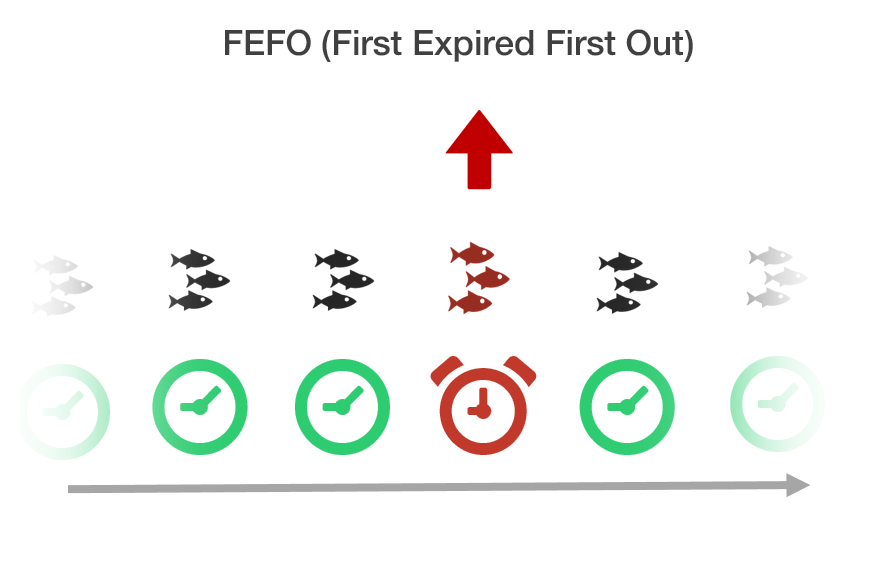
FEFO not only enhances inventory management but also minimizes losses and optimizes supply chains, particularly in industries sensitive to expiration dates such as food, pharmaceuticals, and chemicals. According to the Food and Agriculture Organization (FAO), approximately 1.3 billion tons of food are wasted globally each year, with poor inventory management being a major contributor. FEFO helps mitigate such waste by prioritizing the release of near-expiry products, ensuring they are used before becoming unsellable.
Moreover, strict industry regulations in food and pharmaceuticals make FEFO a necessity for businesses. If expired goods remain in storage, companies risk heavy penalties and reputational damage. Therefore, implementing FEFO is not just a choice but a mandatory standard in industries demanding high levels of quality and safety.
“FEFO not only reduces waste but also provides businesses with a competitive edge, especially in the food and pharmaceutical sectors, where product quality dictates market success.” – Prof. Hau Lee (Stanford), Global Supply Chain Expert.
At a practical level, Mr. Nguyen Huu Minh, Operations Director of an FMCG company in Vietnam, stated: “Without FEFO, businesses could face billions in losses annually due to expired inventory. A modern warehouse system must integrate this method.”
Choosing the Right Method: FEFO, FIFO or LIFO?
Ultimately, no single inventory management method fits all businesses. Each has distinct advantages and limitations in bonded warehouse management. The choice between FEFO, FIFO, or LIFO depends on the nature of the goods and the company’s strategic goals.
For food, pharmaceuticals, and cosmetics businesses, FEFO is the best choice for quality assurance and regulatory compliance. FIFO suits industries requiring rapid inventory turnover, such as electronics and FMCG. Meanwhile, LIFO benefits companies handling raw materials with fluctuating values, like steel and oil.
Therefore, businesses must carefully evaluate and select the most suitable inventory management method to enhance operational efficiency and maximize profitability.